Showing posts with label Movie Comment. Show all posts

Tuesday, 4 January 2011

Musings on A Single Man

An introductory note:
Compared to some of the short and inconsequential text messages a person can read on a daily basis, it's fair to say that one I received recently did its best to stand out. "Finally worked out what that A Single Man film is about," my friend informed me, "It's about loneliness, romanticism, melancholy and the fragility and transitory nature of human connections. And the sadness inherent in that. The film's ending, coming shortly after Firth's character having made a new connection, exemplifies that." It was one heck of a text; especially considering that my friend and I had never previously discussed the film. He must have just assumed that I would be interested - and quite right too.

Though extracted from a piece that I originally wrote in August of last year which was about artists from other mediums trying their hand at film direction (and the effect this might be seen to have on their work), I still think that the description of A Single Man given below does go some way to expressing my analysis of the film. As such, I hope it will prove an interesting comparison. This one's for you, Will...

-------

Last year saw the release of Tom Ford’s debut feature, A Single Man (2009). Directed and co-written by Ford, previously known for his work as a fashion designer, some reviewers were keen to describe the film’s visual focus as little more than an outer covering – a well-cut suit worn by an otherwise unremarkable man. Writing for online publication, Trespass Magazine, Glenn Dunks argued that, although A Single Man may “look perfect”, Ford’s tendency for “preening, polishing and enhancing” means that it “resembles an excessively over-designed photo shoot rather than a film.” An easy claim to make, it is a harder one to support, seemingly having been employed solely to draw cynical comparison with the director’s previous endeavours. No doubt if Ford had been best renowned as a restaurateur reviews would have included wordplays about whether his work had enough ‘flavour’ to live up to its immaculate presentation.

In actuality, A Single Man’s aesthetics are far from vacuous. Using visual cues to represent the heightened senses of a suicidal man, Ford allows his film’s imagery to reinforce thematic content. Convinced that he’s spending his last day on Earth, college lecturer George Falconer (Colin Firth) – the eponymous single man – is beginning to see the world differently and it is through this altered perspective that we witness events unfold. The effect is immediately apparent. With the majority of the film dominated by brown and white – the sets, costumes and camerawork ensuring that George’s life is devoid of any real colour – one could assume that Ford is simply staying true to the story’s early 1960s setting. Yet even Firth’s face is made-up to be remarkably pale, a choice that, paired with his dark suit and white shirt, allows George to merge with his surroundings. Whilst this wan complexion could be seen as indicative of George’s anxiety regarding his imminent suicide attempt, it also serves to reinforce his view of how insubstantial his life seems without the company of his recently deceased lover (Matthew Goode). George’s sinking into the background is not simply a display of Ford’s finesse, but an illustration of the character’s worst fear.

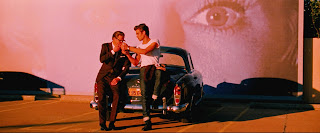
Using this as a visual base, Ford allows sparse instances of colour to elevate otherwise everyday occurrences, emphasising their effect on George’s fragile state. One example of this comes through the film’s repeated close-ups of eyes. Usually adding a striking flash of green or blue to a given scene, they appear most commonly when George is acknowledging another character’s positive traits; “You always look beautiful. Really beautiful”, he tells his secretary on one occasion. Denoting the moments where George feels a rare emotional connection to the world, this focus on eyes again occurs in a scene where he accepts a cigarette from a handsome Spanish stranger. Reluctant at first, it is making eye contact with the man that encourages George to embrace the opportunity. As the pair smoke together, gazing toward a bright sunset, George’s normally drained face becomes illuminated in red. There is a sense during this – the film’s most uncharacteristically colourful moment – that George is experiencing true happiness for the first time since losing his partner. A superb blend of imagery and theme, these scenes demonstrate that Ford’s knowledge of style extends well beyond the realms of fashion.

Thursday, 22 July 2010

Happily Ever After?
The search for a perfect ending.

A note from the writer: this feature discusses endings in modern cinema and as such contains spoiler details regarding the conclusion of each film mentioned. All titles are written in bold so as to alert the reader, but if you don’t want to know the result, look away now...


At the end of Steven Spielberg’s War of the Worlds (2005), our hero Ray (Tom Cruise) arrives in Boston to find not only that his ex-wife’s neighbourhood has been completely untouched by the conflict, but that his son – last seen running toward certain death in an alien fire fight – has somehow both survived and made it there before him. It is a moment so out of kilter with what has occurred before that it immediately seems far less real than the film’s alien tripods. A narrative’s closing moments can have a great impact on our final view of it, making it essential to get things right. However, it is far too easy to mistake the best ending with the one that seems the most satisfying. Does every story need a “happily ever after”?

Log onto the IMDb.com message board for John Frankenheimer’s 1998 film Ronin and you might, as with any film, expect to find debates regarding minor plot holes and possible explanations thereof. Instead though, the page is dominated by posts deriding the feature’s inconclusive ending. “What was in the case?” This is the question repeated over and over. It would seem that in refusing to reveal the contents of a container pursued by Irish and Russian criminals throughout the film, Frankenheimer and his screenwriter (J.D. Zeik), have – in the eyes of many IMDb users – ended the story in an unsatisfactory manner. They have made use of what Alfred Hitchcock referred to as a ‘MacGuffin’ (a device that motivates the characters and advances the plot, but the details of which are of little or no relevance otherwise), but for some viewers human curiosity has allowed the particulars of this object to take up the position of central importance. In reality, the case is incidental. When the true motivations of Robert DeNiro’s undercover CIA agent are revealed, we discover that he doesn't want its contents and, due to his actions, neither the Irish nor the Russian gangs end up getting it. Perhaps this is all we need to know? At the film’s conclusion, Jean Reno’s character, Vincent, tells us in voiceover; “No questions. No answers. That's the business we're in. You just accept it and move on.” He is of course referring to the life of a mercenary, but it could also be seen as a comment on the film as a whole, or indeed aspects of life itself.

There will always be knowledge that we cannot access and, if art is designed to reflect something of life, then why have we come to expect more closure from it than we might get in reality? As children we are raised on fairytales with happy endings, but before that we listen to nursery rhymes where there is often no resolution. Humpty Dumpty cannot be put back together again, Jack and Jill never get their pail of water and it remains unclear as to whether Little Miss Muffet ever gets to finish her curds and whey. This is not to suggest that all stories must finish on a down note, but we should be aware from a young age that not every narrative has to end with all threads neatly tied-off.

Indeed, returning to cinema, it could be said that sometimes the themes of a film can be reinforced far more by an ending that refuses to compromise with what the audience may be expecting. Take, for example, Joel and Ethan Coen’s Fargo (1996). This is a film where, in the end, good people triumph and the greedy are punished for their crimes. It seems ironic then that the dedicated IMDb message board is littered with people lamenting the loss of the $920,000 that Steve Buscemi’s Carl leaves buried in the snow before his untimely demise. The story should be wrapped up, yet - by our very nature - many of us find ourselves wanting to know what happened to all that cash. In her monologue towards the film’s close, Marge Gunderson (Frances McDormand) states that there’s more to life than “a little bit of money”. Of course, the audience are privy to the knowledge that there are much larger sums involved than she is aware, but the point remains; too many of us find ourselves focused on that fictional stash when there is so much more we should take away from this story. Far from problematic though, this can actually be viewed as the screenplay’s creative masterstroke. In leaving audience members debating the fate of the lost money, the Coens have left these viewers unwittingly aligned not with the story’s heroes, but instead with its villains, allowing the film to serve as a fictional parable that calls into question the materialistic priorities of our own lives.

The brothers proved themselves masters of such ‘unsatisfying’ endings with 2007’s No Country for Old Men. By the time of the film’s climax the character assumed to be the story’s hero has died off-screen, his innocent wife’s fate has been left uncertain, the villain has walked away alive and free, and an aging sheriff has been left questioning his worth in this increasingly violent society. Many who saw the feature were left wondering where the resolution was and, of course, there was none. In response to negative reactions to the film’s ending, star Josh Brolin (the aforementioned ‘hero’ of the piece) was quoted as saying:

I love that people leave the movie saying, “I hate the ending. I was so pissed.” Good, it was supposed to piss you off...You completely lend yourself to [my] character and then you’re completely raped of this character. I don’t find it manipulative at all. I find it to be a great homage to that kind of violence.

The film is about the opportunism, greed and violence that can take hold with increased intensity in each new generation born into a morally apathetic society. Aggression and avarice breed in kind and unfortunately it is unlikely that this will lead to a positive outcome. Ultimately the story is perhaps more about Sheriff Ed Tom Bell, as portrayed by Tommy Lee Jones, than it is about Brolin’s character. At the film’s close, Ed Tom describes a dream in which he sees his father “fixin’ to make a fire somewhere out there in all that dark and all that cold”. However, he says that - before he could witness the blaze - he “woke up”, forced to return to reality. Far from being ineffective, this conclusion reinforces what has been suggested by the events throughout. Society has been enveloped by dark, cold realities and those older generations who fail to adapt will find themselves left behind, unable to see or create any change in the situation. It is not the ending that anybody wants for these characters, but it is the ending that best suits the tale.

It could be falsely deduced from such observations that, in order to be effective, a film’s closing moments must set out to thwart audience desire. This is not true. The point of this article is not to suggest that it is essential for filmmakers to leave people confused or pondering loose ends, more that they should not shy away from doing so purely to create a resolution where one isn’t necessary. Sometimes the perfect ending can be conclusive and rewarding, but in other cases it can be uncertain, upsetting, perhaps even frustrating. For each story there is an appropriate denouement that will best compliment the events narrated and themes raised and filmmakers should never be afraid let the right conclusion show.

Perhaps though, to avoid accusations of scepticism, it is best to end this particular commentary with an example of a full resolution executed well. During the same months that No Country for Old Men graced our screens, another feature provided one of the finest endings in recent memory. This one, in contrast to those mentioned above, was brilliant through its conclusiveness. When the final words of Paul Thomas Anderson’s There Will Be Blood (2007) are uttered by aging oil-tycoon Daniel Plainview (Daniel Day-Lewis), they can be seen as carrying at least four different meanings, each firmly suggesting that an endpoint has been reached. As his butler approaches him, Plainview sits on the floor, food strewn across the room from the meal the servant left him eating. A man’s dead body lies nearby, his head caved in by Plainview moments before. Suddenly, speaking as if in answer to the most informal of questions his butler could possibly be thinking...

- Are you done with your meal, Sir?

- Are you through beating that young man to death?

- How do you think this situation will affect your future prospects?

- Do you think this story of your ever decreasing sanity has now run its course?

...Plainview blurts out a casual, two word sentence. It is the absurd yet perfect conclusion to a film that has shown how nonchalantly destructive a man can be when driven solely by power, and – for entirely different reasons – it is the perfect way to end this article. That sentence is simply this; “I’m finished”.

Film review: October (1928)
***1/2

“Peace, Land and Bread,” reads the Bolshevik slogan, pivotal in Sergei Eisenstein’s October (1928). The director visited these themes in 1925’s Battleship Potemkin and, despite moving the setting forward twelve years from 1905 to 1917, October suggests that little has changed. The similarities should not come as a surprise. It was due to Potemkin’s international success and representation of Soviet ideals that Eisenstein was commissioned by the Russian government to make this film; a 10th Anniversary celebration of 1917’s October Revolution. What we see here then is a continued development of the director’s prior work, both in terms of the historical events shown and the methods employed to portray them.

Through his pioneering use of montage, Eisenstein juxtaposes shots in attempt to evoke an intellectual response. In one set-piece depicting the suppression of an anti-government protest, furiously paced cuts between the barrel of a machine-gun and the gunner’s manically smiling face are suggestive not only of the sound and workings of the gun itself, but also of the casual immorality of the establishment forces. As a series of bridges are raised to quell the resulting chaos by separating the workers’ district from the city, Eisenstein contrasts striking shots of a slain horse - hanging over the edge of a slowly rising bridge - with the image of a sphinx-like Egyptian statue. These images, unconnected on the surface, invite the audience to draw similarities with another society that was reliant upon, but wholly mistreated, its working class.

Expertly executed as such sequences are, the film often lacks the tension required to be suggestive of an imminent uprising. As a result, when the remarkable scenes do occur, they seem all too brief, none proving as enduringly memorable as Potemkin’s oft-referenced Odessa steps sequence. It is perhaps for these reasons that the film has never quite matched the acclaim of its predecessor, yet - despite this - October remains a landmark in the artistry of Eisenstein’s technique.

Film review: À ma soeur! (2001)
****

It is rare that anybody’s first sexual encounter occurs exactly as they imagined. Let’s face it; “the right time” with “the right person” hardly ever happens. À Ma Sœur! (2001) follows two adolescent French girls seeking to avoid this trend. Elena (Roxane Mesquida), a pretty 15 year-old, wishes to save herself for her true love. Anaïs though (Anaïs Reboux), Elena’s overweight 12 year-old sister, believes a true love deserves experience and so intends to give herself to a random partner. But on a family holiday to the South of France, Elena is seduced by a handsome Italian four years her senior (Libero de Rienzo) and is soon coerced into sexual experimentation much sooner than she anticipated - all whilst her sister lies awake and watching in the next bed.

Already holding a reputation for her frank meditations on sexuality, writer-director Catherine Breillat does not retreat from showing the uncomfortable results. During the awkward bedroom scenes, Anaïs looks on - attracted and horrified in equal measure - literally watching through her fingers. As the camera lingers steadily on her sister’s intimacy, seemingly invading an already unpleasant moment, this voyeurism is passed onto the audience, forcing them to either witness or recoil. Breillat carries these moments of emotional transference throughout the film. One unnerving sequence, showing a car journey that follows a family dispute, assaults with a visual and aural sense of danger. With each honking horn, high-speed lane change and roar of a passing truck the audience are made passengers, sitting in constant fear of an accident. Breillat’s frequent use of sustained shots and extended scenes ensures that nothing is cut short for emotional relief.

With an ending that comes out of leftfield, yet perfectly complements the story’s themes, this is a film that looks without blinkers at the complexities of familial ties and adolescent sexuality. The picture it paints is not pretty, but Breillat’s startling approach will not fail to make an impression.

Wednesday, 21 July 2010

Film review: Dear Frankie (2004)
***

With a story that is simultaneously optimistic and saddening, Shona Auerbach's Dear Frankie is perhaps best described as the sort of film that makes you smile on a Bank Holiday afternoon spent with your parents. That may sound like a cynical introduction, but picture other charming ‘Sunday afternoon’ fare such as ITV’s Goodnight, Mister Tom (1998), and you may appreciate the compliment.

The film centres on the titular Frankie (Jack McElhone), a nine year-old deaf child, raised in Scotland by his single mother, Lizzie (Emily Mortimer). Frankie believes his father is away at sea, but when news comes in of his dad’s boat docking at the local harbour, it soon becomes apparent that Lizzie has been protecting her son from the truth. If she wishes to continue the charade, a stand-in will be needed; an apprehensive Gerard Butler, credited only as “The Stranger”.

A story about human connections, Dear Frankie hinges upon both writer Andrea Gibb’s restrained script and the understated performances of its cast. Emily Mortimer is suitably enclosed as a woman trying to come to terms with a life permanently unsettled, her sad eyes telling us that she is always thinking of Frankie’s wellbeing, even when searching the town for a new man. Butler also does well, first displaying near disgust at Lizzie’s deceit of her son, before becoming an image of genuine affection during his scenes with Frankie. Perhaps expectedly though, it is the young lead who proves most crucial. Lending Frankie a believable sweetness, McElhone’s performance allows events to progress without crossing the line into unconvincing. As Lizzie and The Stranger grow to trust each other, it is the lovable portrayal of the child between them that makes their connection plausible. Dear Frankie then, is something often unseen; a film that not only acknowledges the narrow gap between sentiment and mawkishness, but passes through it successfully.

Film review: Festival (2005)
**1/2

Comedic, but not romanticised, Festival is writer-director Annie Griffin’s portrayal of life beneath the surface of the Edinburgh Festival Fringe. An ensemble piece, the film weaves together stories as Irish comic, Tommy O’Dwyer (Chris O’Dowd), attempts to seduce a local radio host and comedy competition juror, Joan Gerard (Daniela Nardini), who herself is involved in a clash of personalities with arrogant celebrity comic, Sean Sullivan (Stephen Mangan), a member of her judging panel.

These characters are only a few in a collection of personalities serving to highlight the tensions between the entertainment industry and the personal happiness of its stars. “This is a festival, it’s about fun”, Joan’s producer tells her in one scene and it is this expectation of constant joviality that weighs so heavily upon the lives of entertainers. Indeed, even when Sean and his disillusioned agent, Petra (Raquel Cassidy), are arguing on a hotel staircase, passing tourists assume that they must be witnessing a play. Festivals may bring lives together, but they can also disrupt them. It is this irony that Griffin is interested in.

Sadly though, the director’s approach to her exploration of the showbiz underbelly is not always a success. Take, for example, her unabashed portrayal of sex. The sight of Tommy lifting his face from Joan’s crotch to swig on a Barcardi miniature amuses, but a scene in which a comic whose routine is reliant upon having his hand in a puppet’s rear-end finds himself on the receiving end of his own scenario seems entirely misjudged.

The main problem though is that Festival simply tries to do too much. The central threads engage, but elsewhere characters seem peripheral and weakly drawn - a trio of kooky Canadian performers are little more than a clichéd annoyance, whilst the tragic arc of a clergyman and his one-man show about paedophile priests seems largely unnecessary. Had it been more focused then this bleak comedy could have been a hit, instead though the frequent variation in quality creates a link between entertainment and frustration almost as strong as the one the story attempts to exemplify.

Film review: A Streetcar Named Desire (1951)
*****

Released in 1951, Eliah Kazan’s adaptation of the Tennessee Williams play A Streetcar Named Desire tells of disturbed Southern belle, Blanche DuBois (Vivien Leigh), who arrives in New Orleans seeking refuge with her sister, Stella (Kim Hunter), following the unexpected loss of her family plantation. Bullied and tormented by her brutish brother-in-law, Stanley (Marlon Brando), the secrets of Blanche’s past slowly reveal themselves as she is gradually driven deeper into her own despair. Leigh’s face tells the whole story. Blanche is terrified by the violent dynamic between Stella and Stanley and yet captivated by every male she sees. With her longing eyes and pouting lips, Leigh is constantly expressing newfound love as Blanche seeks solace with one man after another, exposing her desperate desire for protection long before the script does.

But this is Brando’s show. His Stanley is a picture of unrestrained masculinity; his handsome features and imposing physique suggesting he’s equally capable of seduction or violence. His muscular arms are there for Blanche to grasp when startled by an alley-cat, but they also belie an aggressive streak. With his T-shirts perpetually drenched in sweat and his drawling voice coming from a mouth that is almost always mid-chew, he is – as Blanche describes – “an animal”, eating, mating and ruling over the territory of the small apartment set. With Brando’s ability for both restrained anger and outbursts of rage, Stanley’s every smile has the potential to turn to intense wrath. One second he is Blanche’s confidant, the next her attacker, throwing her down and cruelly mocking her. It’s hard to believe a face can simultaneously convey both belittlement and lust, but as Stanley advances on Blanche, jaw still chewing, Brando’s displays just that. A thug to be hated, played by a force that cannot be resisted; like Stella, we want more of him, but are unable to explain why.

Thursday, 13 May 2010

Ordinary Heroes.
Comic book writer Mark Millar on why the superhero genre needs a Kick-[up-the]-Ass.


When you were younger, did you ever wonder how you would fare as a superhero? Not a version of you with bullet-like pace, super strength, or the ability to fly – just plain, old, regular you? If you suspect it probably would have resulted in a horrific beating, imagine no more; Scottish comic book writer Mark Millar has put the scene down on paper so that you don’t have to. The adaptation of Kick-Ass by director Matthew Vaughn and co-writer Jane Goldman is currently riding high at the UK box-office, but it was Millar that first brought the scenario to light. Containing all the savage violence and ‘C’-word dropping children currently enraging film critics at the Daily Mail, it was in his comic that the story first took form. What on Earth was he thinking?

“It’s entirely autobiographical,” laughs Millar, speaking in a recent appearance at the Glasgow Film Festival. “A friend from school and I just loved superhero comics, particularly the realistic stuff, like Alan Moore and Frank Miller, and we thought; ‘let’s do this, let’s try and be superheroes.’” At fifteen years old and weighing in at a combined weight of around sixteen stone, it’s safe to say Millar and his cohort might not have been the most imposing deterrent criminals could ever face, they would have – as Millar now freely admits – ended up in hospital. Fortunately though, circumstance meant that their time of trial never really arrived; “luckily we were in rural Scotland, it was hardly Gotham central.” But this didn’t stop them trying. “We designed costumes and created characters for ourselves,” Millar timidly confesses, “I was called ‘Mr Danger’. I wanted to be like Rorschach from Watchmen, but I looked more like a walking Oxfam advert”. If Millar’s idea wasn’t exactly original, then his friend hardly fared better; “He decided to be Batman!”

Eventually Millar settled for writing superhero stories, rather than starring in them and it seems unlikely that he would regret his decision – he has recently become the biggest selling British comic book writer currently being published in America. Yet even today, as he publicises the second big-screen adaptation of his writing (the first being 2008’s Wanted), he observes his peers’ continued reluctance to let go of other people’s characters. “People always say that Superman and Batman are forever”, Millar tells his audience at the Glasgow Film Theatre, “but they’re not. They’re forever to us because we’re mortal, but things belong to their time and they evolve to become other things. What started off as Hercules five thousand years ago turned into Superman and it’ll be something else in two thousand years time.” The transition, Millar believes, is already underway and, following a conversation with comic book legend, Stan Lee (creator of such massive names as Spider-man and the X-men), the writer has developed an insatiable urge for fresh ideas. “Stan once told me that if he’d just been writing about his favourites then it would have all been Tarzan, Superman and Batman – no Spider-man, no Hulk, nothing. And I thought that was interesting, because now everybody just wants to do Stan’s creations when they could be doing their own.” Today, the much loved tree-swinger of Lee’s generation has as good as died out from the world of comics, how long will it be before the others follow suit? “I think we’re coming to the end of those 20th Century heroes,” Millar comments, “Don’t get me wrong, I’ve got Christopher Reeve’s cape from Superman hanging on my wall at home – those characters means a lot to me – but I see that as a particular period in my life. I just think they belong to a different era”.

It’s about time, Millar believes, that the industry produced some new heroes, rather than relying on those that have gone before. Ever the creative mind, he has his own way of describing the situation. “The way I think of it is to imagine somebody who’s thinking of starting a family. They don’t think; ‘Let’s try to resuscitate that old man and then maybe we’ll adopt him,’ they think; ‘Let’s just have a baby.’” A new generation of readers calls for a new generation of characters, and Millar – to continue his metaphor – hopes that he can help give birth to them. Nonetheless, he acknowledges that certain archetypes will always remain relevant. “There’s a line we can draw from the Golden Age of comics to now where you can see character types developing; Clark Kent and Peter Parker are kind of similar and I’ve tried to carry that lineage through with Kick-Ass.”

So, is Dave Lizewski (the eponymous Kick-Ass) the sort of super-nerd the 21st Century needs? Millar would like to think so. It’s a bold claim, but the writer assures people that he is not attempting to put himself on a creative pedestal. “I think a lot of is to do with the timing as opposed to the quality of the work. I think this generation doesn’t have its Spider-man yet, it forms a vacuum.” Millar is just lucky that his work has been given the opportunity to fill the void. But, at this stage, it is still just that – an opportunity. In order for a hero to be successful today, simply conquering the comic book medium isn’t enough; there is another art form that craves new and occasionally radioactive, blood. Hollywood has been riding high on the superheroes for a number of years now and with 2008 not only yielding the record breaking The Dark Knight, but also a summer blockbuster for the previously B-list hero, Iron Man, the genre is showing no signs of slowing down. That is, of course, until it runs out of characters. “I think that’s one of the reasons Kick-Ass became a movie within months of the comic book,” Millar muses, “there’s just such a hunger for it. Sony have bought the rights to my last story, War Heroes, and I’ve already had people ask me about my next book, Nemesis. Hollywood just eats up ideas so fast.”

It’s interesting that Hollywood should suddenly take such a strong interest in Millar’s work. When director Matthew Vaughn originally tried to pitch the idea of an adaptation of Kick-Ass, every major studio refused involvement unless drastic changes were made. The main bone of contention was Hit Girl – played in the film by Chloë Moretz. A supporting character in Millar’s story, she is an 11 year-old girl raised by her father, Big Daddy, to become not just a superhero, but a criminal killing machine – a stark contrast to the protagonist Dave’s more nervous approach. Oh, and she also happens to have a mouth like a sailor. For some reason producers seemed to think there was something unmarketable about the ultra-violent, swear-spouting, pre-pubescent youngster.

Considering some of the awkward territory Millar enters even speaking of her casting process, perhaps this is not surprising. “I was on a train, talking on my mobile, and I just went into a little bubble where I forgot other people could hear me. ‘Matthew and I have had a brilliant few days,’ I said, ‘we’ve just been watching DVDs of loads of wee girls!’” It’s the sort of discussion that would usually see your name joining a criminal register, rather than the box-office top ten. But a new kind of superhero film needs a new kind of approach and this is exactly what Vaughn and Millar opted for, deciding to fund the film independently before enticing distributors by revealing the first rapturously received clips at 2009’s San Diego Comic-Con. It’s a choice that Millar feels was essential to the film’s success. “If we had done Kick-Ass with the studios it would have been a sanitised mess and probably wouldn’t have even made it out theatrically. Doing it outside the system let us make the movie we really wanted to make” – 11 year-old assassins and all.

With an admirable share of positive reviews suggesting that the filmmakers were right to stick to their guns, the dust of controversy surrounding Kick-Ass may well be settling, but this doesn’t mean that Millar is ready to stop playing with convention. “I’d like to do a superhero film set in Scotland”, the writer reveals, speaking of a possible foray into directing. “I want to do something as cool as District 9 was to South Africa. I think it’s really interesting when people juxtapose two things you wouldn’t often see together – like alien invasion and South African politics. So I thought; superheroes and Scotland.” If the concept sounds a little BBC on paper, don’t worry, Millar – as always – has his own vision. “I really like Alan Clarke stuff, like Scum [1979]. I love the way it’s so raw and real. I think it’d be great to do superhero movie like that. I think it could be really epic; something unlike anything anybody’s ever seen before.” After seeing Kick-Ass, it’s easy to believe him.

Film review: Salesman (1968)
****


The American Dream is not about how much you can achieve, but how much you can attain. What could reflect this more than the commercialisation of the very Faith the nation was founded on? Released in 1968, Salesman is a documentary confronting the realities of door-to-door Bible selling, a job founded solely on the principle that its product is one of the biggest sellers in the world. If you’re not making money as a Bible salesman, as one manager tells his workforce in the film, “it’s your fault”.

Enter Paul Brennan (otherwise known as “The Badger”). Travelling from city to city, hotel to hotel, Paul is “living like a king” – or so his wife tells him. Chances are Paul once believed it too. Now though, constantly shuffling from one client to the next, becoming more insistent and aggravated with each failed sale, Paul seems increasingly desperate. Firing off clichés in attempt to sway an audience of housewives, he is himself an upsetting stereotype – Death of a Salesman’s Willy Loman transported into the real world. Other salesmen are briefly introduced throughout, but ultimately they serve only as an illustration of how Paul could be, or may once have been.

The black and white handheld camerawork heightens the dreariness of the scenes, but by showing events from a fly-on-the-wall perspective directors Albert and David Maysles largely allow the circumstances to speak for themselves. Yet it is still possible to question the film's ability to showcase uninfluenced authenticity. It is not clear, for example, how far camera presence may have affected clients during sales (one woman of Polish descent seems particularly uncomfortable turning Paul down on film, drawing out the anxiety of his failing pitch), and some scenes feel as if they may have been re-shot more than once. In spite of this though, Salesman remains poignant and saddening; a portrait of one man's loss of purpose, painted in shades of grey. On its release, Vincent Canby wrote in The New York Times: “It's such a fine, pure picture of a small section of American life that I can't imagine its ever seeming irrelevant”. He’s yet to be proved wrong.

Friday, 31 July 2009

"A Serious Man"
- New Coen Brothers trailer online.

It seems like only a few months back we were chuckling (for the most part) at the exploits of Brad Pitt, George Clooney and John Malkovich in the Coen spy comedy, Burn After Reading. Made rather speedily on the heels of the multi-Oscar winning success of No Country For Old Men, and starring the Coens' most eye-catchingly A-list cast to date, you could be forgiven for believing that the Coens were heading in a direction a little less leftfield and little more universally accessible. Whilst it could have been feared that this may lead them closer to the dangerous territory of the Intolerable Cruelty and Ladykiller days (usually acknowledged as the Coens' least, well, Coen-like, works and also their worst), the film itself went some way to prove that, regardless of a star cast, the Coens' are still masters of creating a unique mix of comedy, weirdness and violence never quite seen anywhere else.

Yesterday Empire Online brought news of the trailer for the Brothers' latest offering, A Serious Man. Set in 1967, it tells the story of Larry Gopnik (Michael Stuhlbarg), a Jewish academic who's up for tenure and facing a series of personal crises. His wife (Sari Wagner Lennick) wants a divorce so she can marry his colleague (Fred Melamed); his brother (Richard Kind) is living on his sofa and his children are stealing from him. He looks for advice from three different rabbis, but doesn't get exactly what he's looking for. It has the potential to be pretty bleak, yet it also has the potential - if done right - to be very funny. In other words, it has the potential to be very Coen. And not a star name in sight!

Check the preview out below:

I personally think the trailer is wonderfully done. It gives away suitably little, and yet at the same time it feels like it may be giving artful set-up to the themes and atmosphere of the film. The looping sounds and images give the impression of a man who's sad life has left him trapped in a never-ending cycle, desperate for help - whilst shots of scratched teeth and Larry spying on his sunbathing neighbour seem to suggest a more sinister element. And it all builds up to a great punchline exchange. Imagine that the Coen filmography that rolls near the end were a list of credits and the whole edit could almost be presented as a short film in itself.

I have to admit that I was beginning to worry that the Coens may be getting over prolific after their No Country success and would start rushing out lower quality films, with more focus on big names than unique ideas - I mean Burn After Reading was good, but it wasn't quite their best. However, from this trailer, A Serious Man looks like a great return to their shades of brown and grey, wonderfully odd 20th century period films, like Barton Fink (one of my favourites). Encouraging stuff! I await this one eagerly.